
About
I’m a mathematical physicist who works on both theory and its practical applications, from non-equilibrium statistical mechanics to numerical solvers for real proteins.
I hold a Ph.D. in Pure and Applied Mathematics from Politecnico di Torino and the Istituto Italiano di Tecnologia. Today I work on protein–protein interactions and binding affinity through continuum electrostatics, and on the numerical solvers that make those calculations fast and accurate, starting from NextGenPB, the Poisson–Boltzmann solver I developed with my co-authors.
I also work on non-equilibrium statistical mechanics. If you are interested in collaborations in computational physics, biomolecular modelling or high-performance scientific software, write to me.
- Now
- Post-doctoral research fellow, MOX laboratory, Department of Mathematics, Politecnico di Milano (2025–)
- Ph.D.
- Pure and Applied Mathematics, Politecnico di Torino and IIT (2021–2025)
- Internships
- City College of New York, 2024 · SISSA, Trieste, 2018
- Grant
- Principal Investigator of a PRACE-FENIX 2025 cloud computing grant, 2026–2027
Research
Protein–protein binding
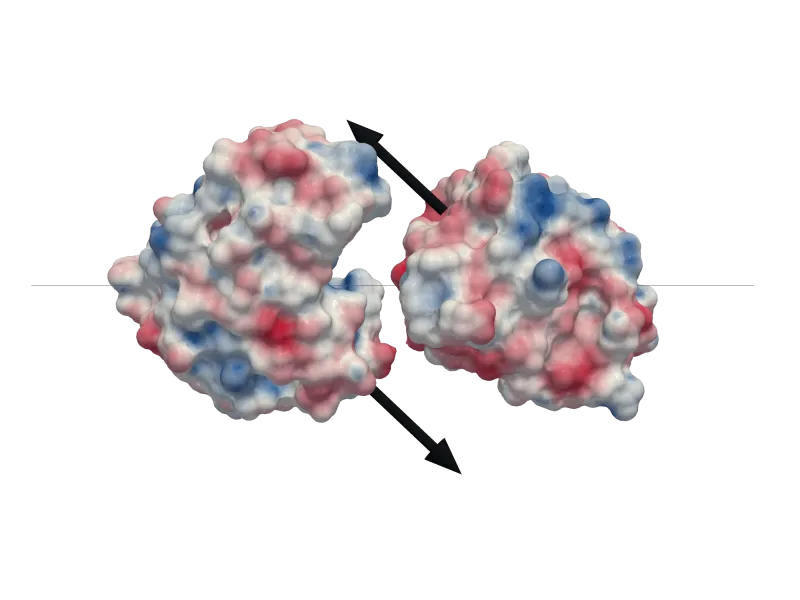
How proteins recognise and bind each other, studied through continuum electrostatics: electrostatic complementarity at biomolecular interfaces, interaction forces and binding affinity.
Poisson–Boltzmann solvers
Efficient numerical methods for the Poisson–Boltzmann equation. NextGenPB uses finite elements, analytical super-resolution and a mesh refined only where the molecular surface is. I also work on data-driven surrogates that speed these calculations up.
Non-equilibrium statistical mechanics
The behaviour of low-dimensional systems far from equilibrium, from heat conduction in one-dimensional chains to the Boltzmann equation.
Projects
-
NextGenPB
Solver for biomolecular electrostatics based on the Poisson–Boltzmann equation, with analytical super-resolution and local mesh refinement. Integrated in the MCCE workflow for pKa calculations. CodeTutorialPaper
From atoms to electrostatic potential
The atoms of barnase and barstar above the plane, with their bonds.
The molecular surface around them, the boundary between the low-dielectric protein and the water.
An octree mesh: uniform and fine around the molecules, so every cell the surface cuts is at the finest level, then coarser level after level towards the boundary.
The potential on the molecular surface, from the nonlinear Poisson–Boltzmann equation at 0.145 M: red negative, blue positive.
Barnase and barstar (PDB 1BRS), barstar moved 10 Å from the crystal pose, cut by the plane of the mesh. Surface and potential computed with NextGenPB; the surface is simplified for the drawing, and mesh cells are drawn about seven times larger than the real 0.5 Å. -
Analytical electrostatics
Analytical tools for the electrostatic modelling of macromolecules and proteins in electrolytic environments. Code
-
1D chains
Selected publications
All publications and talks- 2025
- 2026
- 2024
Teaching
- Advanced Methods for Scientific Computing
Teaching assistant · Department of Mathematics, Politecnico di Milano - Mathematical Physics
Tutor · School of Industrial and Information Engineering, Politecnico di Milano - Methods for Environmental Engineering
Tutor · Politecnico di Torino - Calculus 1
Teaching assistant · Politecnico di Torino - Physics 1
Teaching assistant · Università di Torino
- Recent talks
- SIAM PP26, Berlin, 2026 · GIMC SIMAI Young, Pisa, 2026 · ICIAM, Tokyo, 2023
- Recent posters
- EuroQSAR, Perugia, 2026 · Protein Electrostatics, Lisbon, 2025 · ACS Fall, Denver, 2024
- Everything else
- Curriculum vitae · CV for industry (PDF)